
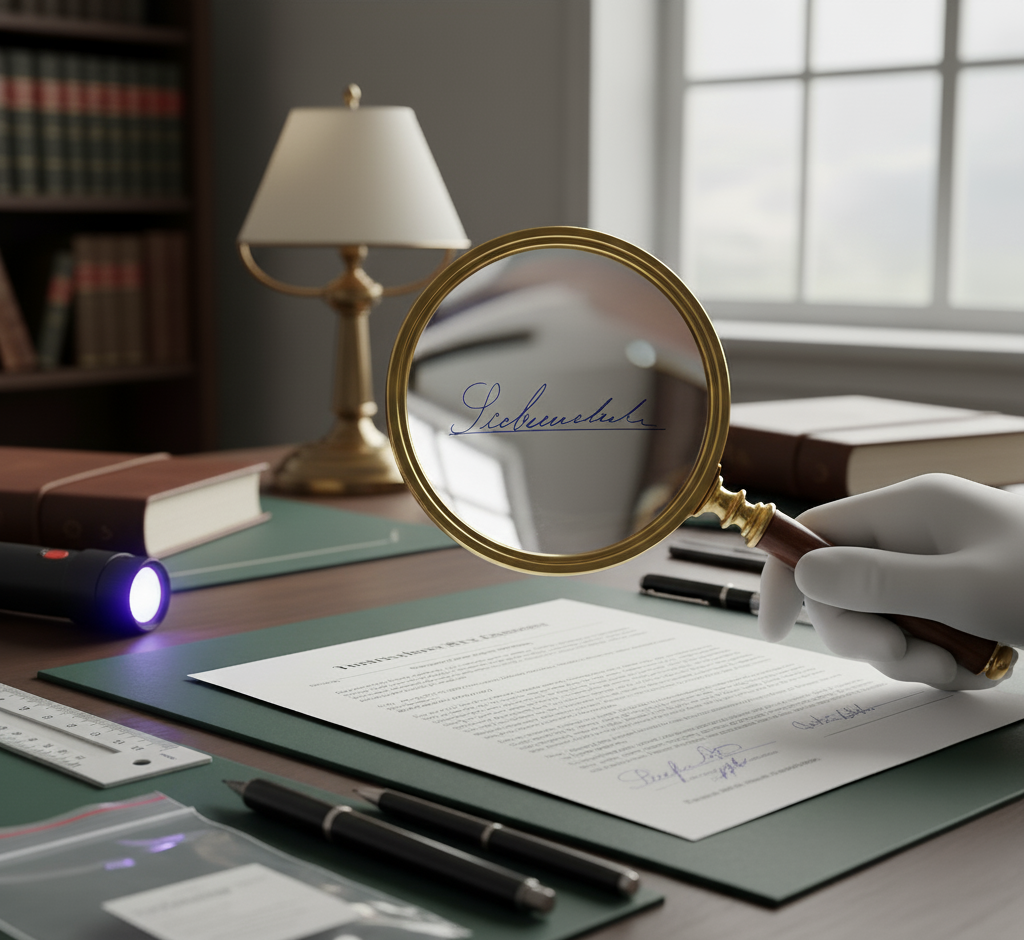
In the high stakes world of legal disputes, business transactions, and personal affairs, the authenticity of a document can make or break a case. Whether it’s a will, a contract, a deed, or a handwritten note, questions of genuineness often arise. Most people believe they possess an innate ability to spot a fake, a shaky signature, an odd ink colour, or an unusual pen stroke. While these observations might spark suspicion, they are, at best, a hunch. And in a courtroom, a hunch is a liability, not evidence.
The Illusion of Expertise: Why Your Eyes Aren’t Enough
The human eye is an incredible instrument, but it has severe limitations when faced with a sophisticated forgery. Modern forgers employ techniques designed specifically to circumvent casual scrutiny. They can mimic handwriting, erase text chemically, or even subtly alter dates without leaving obvious visual cues. Relying solely on looking closely is just like trying to diagnose a complex medical condition with just a glance, it simply won’t yield reliable results.
The Price of a Hunch: When Guesses Fail in Court
Imagine presenting your case, convinced a document is fraudulent because it just looks off. Under cross examination, you’d be asked for specifics, for scientific proof. Your inability to provide concrete, objective evidence would lead to your testimony being dismissed as mere speculation. The opposing counsel would highlight your lack of expertise, and your critical piece of evidence, or your argument against it, would crumble. In the legal arena, certainty is paramount, and certainty comes from science, not intuition.
The Science of Certainty: Tools of the Trade
At XForensics, we remove guesswork from the equation by using scientific forensic technology and methodologies. This isn’t about guesswork; it’s about irrefutable data.
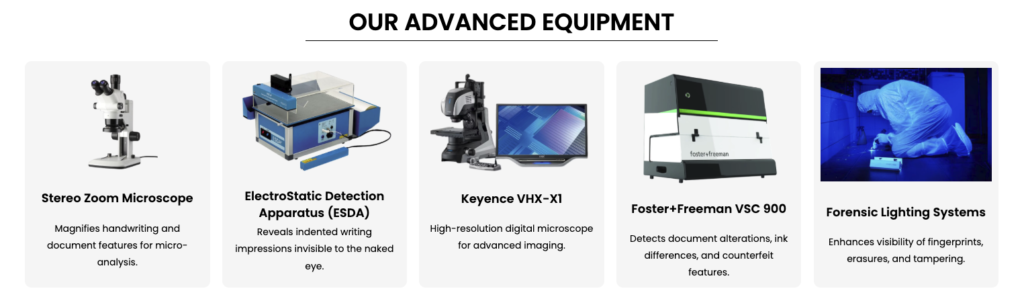
- Video Spectral Comparator (VSC): This powerful instrument doesn’t just look at documents; it analyses them across a spectrum of light, from ultraviolet (UV) to infrared (IR). What might appear as a consistent ink under normal light can reveal itself as two different inks, obliterations, or subtle alterations when subjected to specific wavelengths. It can uncover:
- Alterations and Additions: Revealing text written at different times or with different pens.
- Obliterations: Making erased or blacked out text visible.
- Ink Differentiation: Proving that multiple inks, even visually similar ones, were used.
- Electrostatic Detection Apparatus (ESDA): This incredible non destructive technique is used to reveal indented writing. When you write on a pad of paper, impressions are often left on the sheets underneath. Even if the original written sheet is long gone, the ESDA can develop an electrostatic image of these indentations, revealing what was written. This can be crucial in cases involving suicide notes, anonymous letters, or proving the content of previous drafts.
- Microscopic Analysis & Ink Chemistry Databases: Beyond these primary tools, forensic document examiners utilise high powered microscopes to observe minute details of pen strokes, paper fibers, and printing processes. We also access extensive databases of ink formulations, allowing us to determine the age of ink, the type of pen used, and even compare ink samples to identify common sources.
Don’t Bet Your Case on Your Eyesight. The integrity of your documents is too critical to leave to chance. Whether you’re a legal professional building a case, a business owner safeguarding contracts, or an individual dealing with a contested will, expert forensic document examination provides the definitive answers you need. It transforms doubt into evidence, hunches into scientific fact.
In today’s complex world, expertise is specialised for a reason. Just as you wouldn’t perform surgery on yourself, you shouldn’t attempt to authenticate critical documents without professional help. XForensics provides the unbiased, scientific certainty required to stand strong in any legal or professional challenge.
Ready for the Science of Certainty? If you have a document whose authenticity is in question, don’t rely on a hunch.
Contact the experts at XForensics: 📞 +1 (587) 739-5678 📧 xforensics.ca@gmail.com 🌐 xforensics.ca