
Here’s something that happened last month: A business owner called about a contract dispute worth $200,000. She knew something was off but couldn’t prove it. Turns out, someone had added an extra zero to a payment clause after everyone signed. The difference between “20,000” and “200,000” nearly bankrupted her company.
This stuff happens more than you think. And knowing when to get help can save you serious money and headaches.
The Bottom Line Up Front
If you’re dealing with a questioned document, here’s what matters most:
Act fast. Documents degrade, people’s memories fade, and legal deadlines don’t wait. The earlier you get expert eyes on a problem, the more options you have.
Originals matter. Never send your only copy anywhere, but understand that photocopies hide crucial evidence. A document examiner needs to see the real thing to spot alterations, pressure patterns, and ink differences.
Trust your gut. If something feels wrong with a signature or document, there’s probably a reason. You don’t need to be an expert to sense when things don’t add up.
When You Actually Need This
Look, not every disputed signature needs forensic analysis. But here are situations where calling a handwriting expert makes complete sense:
Someone died and the will seems sketchy. Maybe your parent’s signature looks shaky in a way that doesn’t match their condition at the time. Maybe a new beneficiary suddenly appeared. Maybe the whole thing was supposedly signed a week before they passed, but nobody knew about it. These questions destroy families. Getting objective answers helps everyone move forward.
A business deal went sideways. You’re looking at a contract, and the terms aren’t what you remember agreeing to. Or someone claims you signed something you definitely didn’t sign. Or pages seem to have been swapped. In business, this kind of fraud can cost you everything you’ve built.
Your ex forged your signature. This happens with disturbing frequency. Refinancing documents, loan applications, legal forms. When someone has access to examples of your signature and knows your personal information, forgery becomes tempting. And dangerous.
An employee might be stealing. Forged signatures on cheques, altered invoices, fake authorization forms. One company lost $80,000 before they realized their bookkeeper had been signing the owner’s name to cheques for months.
What Actually Happens During Examination
Forget what you’ve seen on TV. Real document examination is methodical and scientific, but the concept is straightforward.
Examiners compare your questioned signature or handwriting against known authentic samples. They’re looking at how you form letters, how you connect strokes, the pressure you use, your spacing, your slant. Everyone has dozens of tiny habits in their writing that are incredibly hard to fake consistently.
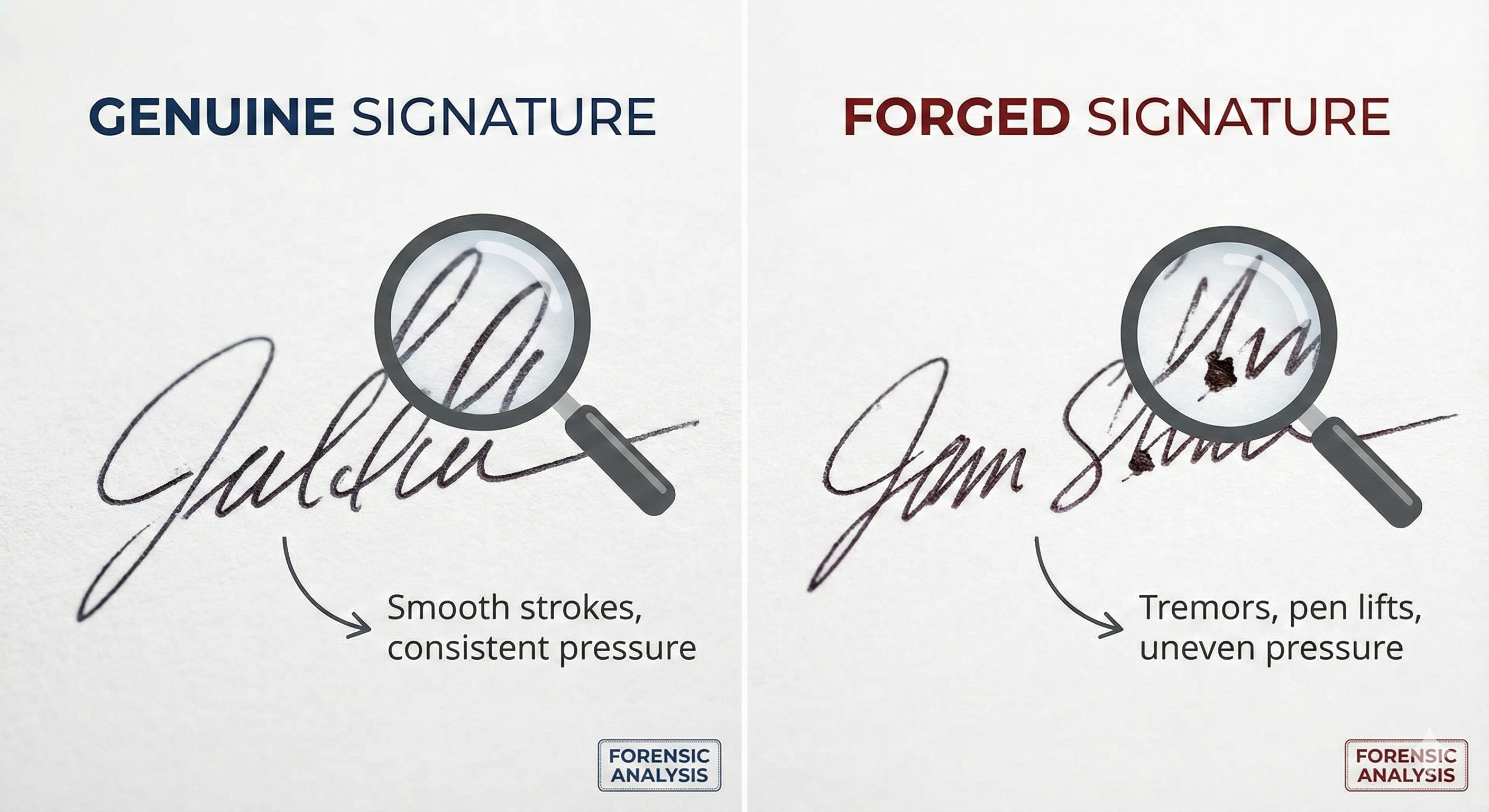
Under high magnification, the difference between someone writing naturally and someone carefully copying becomes obvious. Natural writing flows. Forgeries hesitate. You can actually see where someone stopped, repositioned their pen, and started again. You can see tremor that shouldn’t be there or unnatural smoothness that gives away tracing.
For altered documents, examiners look for disrupted paper fibers from erasures, different inks, writing that goes over fold lines that shouldn’t exist yet, and sequences that don’t make sense. Modern equipment can reveal things completely invisible to your eye.
The Real Cost of Waiting
Here’s the thing nobody talks about: delay costs you.
That disputed will? If you wait six months to challenge it, witnesses move away, memories get fuzzy, and courts start wondering why you didn’t act sooner if you were really concerned.
That forged contract? While you’re debating whether to get it examined, the other party is building their case around it being legitimate. They’re creating a paper trail that supports their version of events.
That employee fraud? Every week you wait is another week of losses piling up.
Professional examination isn’t cheap, but it’s almost always cheaper than the alternative. A few thousand dollars for expert analysis beats losing hundreds of thousands in a bad judgment or settlement.
What You Should Look For in an Examiner
Not everyone calling themselves a handwriting expert has real qualifications. Here’s what matters:
Proper training and certification. This isn’t a field you can learn from YouTube. Real examiners have extensive formal training and recognized credentials.
Court experience. Can they defend their findings under cross examination? Have they actually testified as experts before?
Clear communication. Technical jargon doesn’t help you. You need someone who can explain findings in plain English and make them understandable to judges, juries, and opposing counsel.
Honest about limitations. Good examiners tell you when there isn’t enough evidence to reach a conclusion. They don’t overstate certainty or promise results they can’t deliver.
Making the Decision
If you’re reading this, you probably already suspect you need help. Maybe you’re just not sure if your situation justifies the expense.
Here’s a simple test: What’s at stake?
If it’s a $500 dispute, probably not worth professional examination. If it’s your inheritance, your business, your freedom, or your financial future? Absolutely worth it.
Think about what happens if you’re wrong. If you accept that questioned signature as real and it turns out to be forged, what does that cost you? If you challenge it without expert backing and lose, where does that leave you?
Professional document examination through qualified services like XForensics gives you objective answers backed by scientific analysis and expert testimony. It removes the guesswork and provides evidence that actually holds up in court.
Taking Action
Stop agonizing and start moving. If you’ve got a questioned document, get a consultation. Most examiners will give you a straight assessment of whether examination makes sense for your situation.
Gather your authentic signature samples if you have them. Get copies of the questioned documents organized. Write down your timeline and concerns while they’re fresh in your mind.
The truth is usually there in the documents. You just need someone with the training and equipment to find it and present it in a way that matters legally.
Document fraud happens to smart people every day. The difference between those who recover and those who don’t often comes down to one decision: getting expert help before it’s too late.
Get help immediately, fill out the form at XForensics.ca and we’ll get back to you within 24 hours.